

Tahoe Chain Controls Explained: R1, R2, R3 and What Your Car Actually Needs for I-80 and US-50
What R1, R2 and R3 chain controls mean on I-80 and US-50, whether AWD needs chains, the 6/32 snow tire rule, and pre-trip checks for Roseville and Rancho.

What do R1, R2 and R3 mean on I-80 and US-50?
Short answer: R1 means chains unless you have snow tires on your drive wheels. R2 means chains unless you have four-wheel or all-wheel drive with snow tires on all four. R3 means chains on everyone. You must carry chains either way. Quality Tune-Up Shops in Roseville and Rancho Cordova can check your car before the drive up.
Those three codes are Caltrans shorthand for chain control levels in the Sierra. You'll hear them on traffic reports every time a storm rolls over Donner Summit or Echo Summit. Here's what each one asks of a regular car, SUV or pickup.
| Level | Who has to put chains on | Who can skip installing them (still must carry them) |
|---|---|---|
| R1 | Most vehicles, and anything towing a trailer | Passenger cars and light trucks under 6,000 lbs gross weight with snow tires on at least two drive wheels |
| R2 | Everyone except the exception below | Four-wheel or all-wheel drive vehicles with snow-tread tires on all four wheels |
| R3 | Every vehicle, no exceptions | Nobody |
Caltrans says R1 and R2 are the ones you'll see most. A highway is often closed before R3 goes up.

One detail surprises people. According to Caltrans, the roadside signs don't print the R1 or R2 code. The signs spell out who's exempt. Follow the sign or the CHP officer at the checkpoint, even if the radio said something different.
A few more rules from Caltrans worth knowing before you leave the valley:
- Speed limit with chains: 25 or 30 mph, as posted.
- Where to chain up: you usually get about a mile between the "Chains Required" sign and the checkpoint. Pull completely off the road to the right. Never stop in a traffic lane.
- Taking them off: wait until you pass the "End of Chain Control" sign and find a pull-off.
- Chain installers: they're independent businesspeople, not Caltrans employees, and they aren't allowed to sell or rent chains. Get a receipt with their badge number.
Do AWD and 4WD vehicles need chains in California?
They need to carry them, every time. Under R1 and R2, a 4WD or AWD vehicle with snow-tread tires on all four wheels can usually skip installing them. It still has to have chains on board.
Caltrans treats all-wheel drive the same as four-wheel drive for chain control. That covers most of the Subarus, RAV4s and crossovers headed up I-80 on a winter Friday. If conditions get worse or you start losing control, you have to stop and put the chains on.
No chains in the car? Caltrans says vehicles without them aren't allowed into a chain control area. You get turned around and sent back down to a lower elevation. That's a long, quiet drive back to Auburn.
Two more things for AWD and 4WD owners:
- Which axle: chains go on the drive axle. On AWD and 4WD, Caltrans says either axle works but the rear is preferred, unless your owner's manual says front.
- "My manual says no chains": Caltrans still requires a traction device. Many cars that can't take link chains will accept cable chains or other approved devices. Check the owner's manual for what fits.
What counts as a snow tire, and how much tread does it need?
A snow tire, for chain control purposes, has "M+S," "M/S," "M-S" or "Mud and Snow" on the sidewall and at least 6/32 inch of tread left.
A lot of all-season tires sold here carry the M+S mark. So your everyday tires may count. The catch is the tread depth. Caltrans says 6/32 inch is about half of a new tire's original tread, and plenty of commuter tires around Sacramento are below that by their second winter.

How to check yours in the driveway:
- Read the sidewall. Look for M+S, M/S, M-S or the words Mud and Snow near the size markings.
- Measure the tread. A tread depth gauge from any auto parts store reads in 32nds. Check the inside, middle and outside of each tire.
- Use the lowest number. If any part of a drive tire is under 6/32, don't count on it as a snow tire.
- Check the pressure cold. It drops as the temperature drops. Our post on why the tire pressure light comes on in the cold explains it.
Studded tires are a separate thing. Caltrans allows them from November 1 to April 30, but they don't count as traction devices. You still carry chains.
How do you pick the right chains and practice putting them on?
Buy chains made for your exact tire size, then put them on once at home before you need them.
Your tire size is printed on the sidewall, something like 225/65R17. Chains are sold by size. If your car has aftermarket wheels or a different size than stock, use what's actually mounted. Caltrans doesn't recommend brands, and it points drivers to the vehicle maker's specs for chain use.
Here's the practice run we tell people to do:
- Open the box at home. Untangle the chains and read the instructions in daylight.
- Find your drive wheels. Front-wheel drive gets chains on the front. Rear-wheel drive goes on the back. AWD, see your manual.
- Do a full install in the driveway. Time yourself. Tighten, roll the car a few feet, and tighten again.
- Pack a kit with them. Gloves, a flashlight, a kneeling pad or old towel, and a plastic bag for wet chains on the way home.
- Check clearance. Low-profile tires and tight wheel wells can rub. If anything touches, ask about cable chains or another approved device.
The chain-up area at Kingvale in a snowstorm is a bad place to read the instructions for the first time.
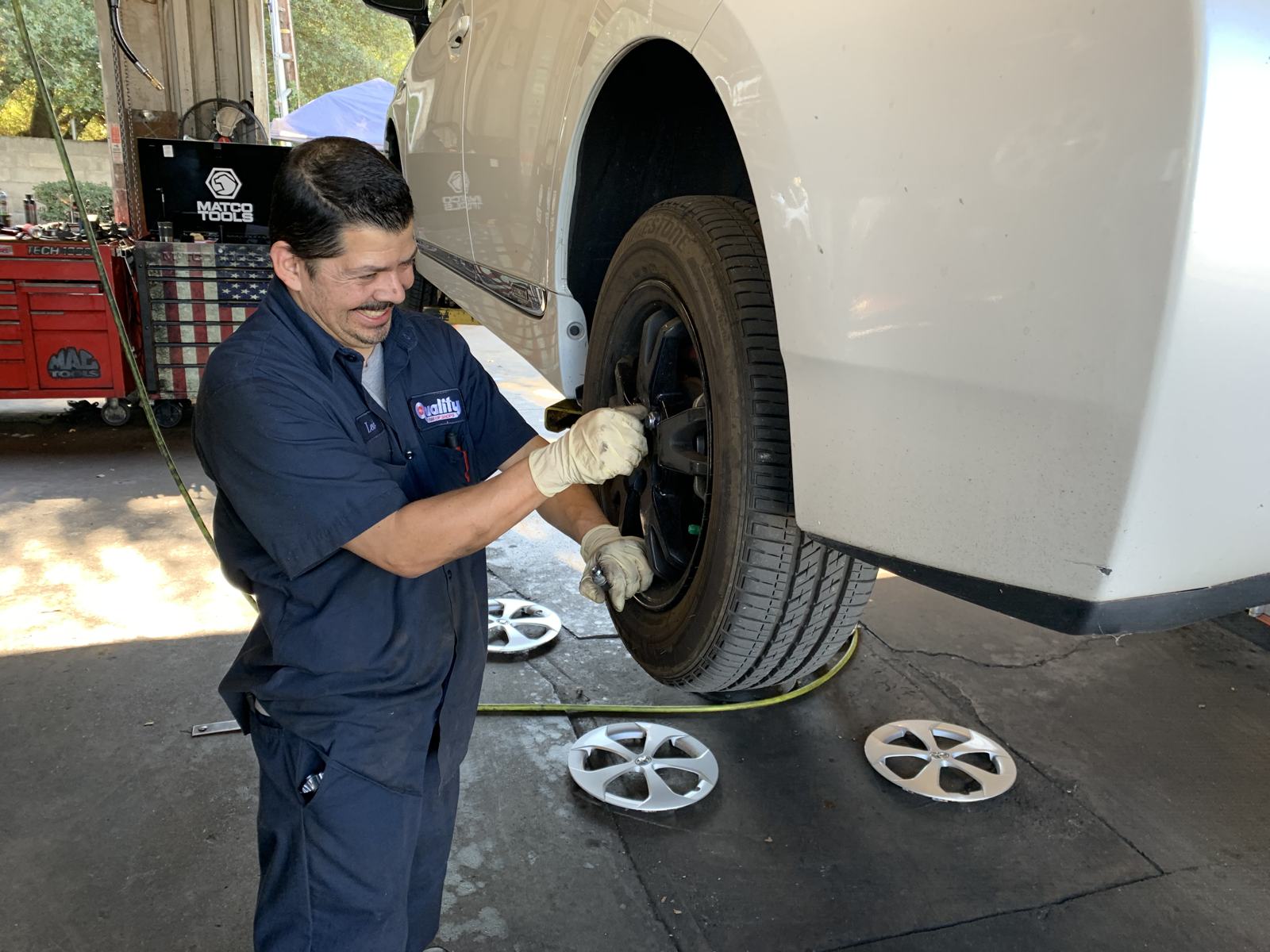
What should you check on your car before driving to Tahoe?
Tires, brakes, coolant, wipers and the battery. Those are the things that leave people stuck on the shoulder at 6,000 feet.
- Tires. Tread depth and pressure, as above. Look for bulges or cords showing too.
- Brakes. Coming back down from Donner or Echo Summit means miles of downhill. Squealing, grinding or a soft pedal needs a look before the trip. Our brake maintenance page covers what we inspect.
- Coolant (antifreeze). Coolant keeps the engine from freezing in the cold, not only from overheating in July. Old coolant also turns corrosive. Our cooling system service includes a pressure test of the system and radiator cap.
- Wipers and washer fluid. Fill up with winter-formula washer fluid. One storm can use most of a reservoir. Our headlight and wiper check takes ten minutes.
- Battery. Cold weather is hard on a weak battery. If yours cranks slowly in Roseville, it'll be worse at Kingvale. Get it tested before you go.
- Emergency stuff. A full tank, warm layers, water, snacks and a phone charger. Storm backups on I-80 can leave you sitting for a long time.
Our older posts on winter tire tips and the car winterization checklist go deeper on fluids, belts and hoses.
Leaving from Roseville or Rancho Cordova: where should you stop for service?
Get it done in the valley a few days before the trip, not the morning you leave. Our Roseville shop sits right off I-80, and our Rancho Cordova shop is just off the 50.
Heading up I-80. Quality Tune-Up Roseville is at 1700 Douglas Blvd, about a quarter mile east of I-80. It's an easy stop for drivers from Roseville, Granite Bay, Rocklin, Citrus Heights and Loomis. From there it's I-80 through Auburn. Caltrans' first chain control checkpoint on the way up is at Applegate, around 2,020 feet. Higher up, the Kingvale checkpoint sits near 6,070 feet, below Donner Summit.
Heading up the 50. Quality Tune-Up Rancho Cordova is at 10801 Folsom Blvd, between Zinfandel Dr and Sunrise Blvd. It's close for Gold River, Rosemont, Mather and the west side of Folsom. Caltrans lists US-50 checkpoints from the east edge of Placerville through Pollock Pines, Twin Bridges (6,158 feet) and Meyers. The Echo Summit checkpoint is at 7,401 feet.
Taking Hwy 88 over Carson Pass instead? Caltrans runs chain control points on that road too, from Cook's Station up past Kirkwood.
Check conditions right before you leave and again in Auburn or Placerville. Use Caltrans QuickMap or call the Caltrans Highway Information Network at 800-427-7623. Controls can change fast.
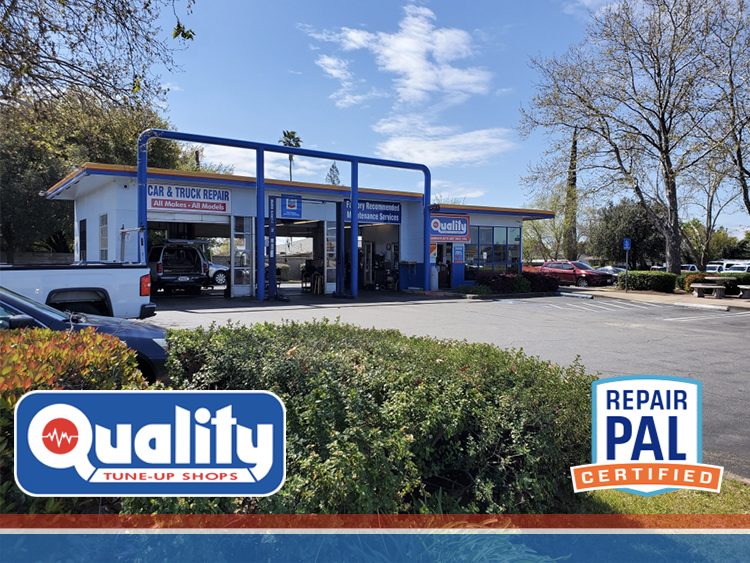
Stop in for a pre-Tahoe check at Quality Tune-Up Roseville (1700 Douglas Blvd, Roseville, CA 95661, 916-783-8862) or Quality Tune-Up Rancho Cordova (10801 Folsom Blvd, Rancho Cordova, CA 95670, 916-635-0500). No appointment needed. Ask for the Fall Special, which includes an oil change, a 16-point safety and maintenance inspection, a brake inspection and a tire rotation. See it on the Roseville coupons page or the Rancho Cordova coupons page (good through Nov 30, 2026). Coolant due? Check the Managers Special on radiator flush too. Learn more about our preventive maintenance. Open Mon–Fri 8–6, Sat 8–5.
Common questions
Do I need chains if I have all-wheel drive in California?
You need to carry them. Caltrans treats AWD the same as 4WD, so with snow-tread tires on all four wheels you can usually skip installing them under R1 and R2. Under R3, everyone chains up.
What does R2 mean on I-80?
Chains or traction devices are required on every vehicle except four-wheel or all-wheel drive vehicles with snow-tread tires on all four wheels. Those vehicles still have to carry chains.
What is the speed limit with chains on?
Caltrans says the limit when chains are required is 25 or 30 mph. Watch for the posted signs.
Can I get fined for not carrying chains?
Caltrans says you can be cited by the CHP and fined if you don't install chains when the signs require them. Without chains in the car, you won't be allowed into the chain control area at all.
What tread depth do snow tires need in California?
At least 6/32 inch, according to Caltrans, plus an M+S, M/S, M-S or Mud and Snow marking on the sidewall.
Sources, accessed November 3, 2026: Caltrans, Chain Controls / Chain Installation and Truck Chain Requirements and FAQ. Caltrans chain control point data for Districts 3 and 10 (checkpoint names and elevations). Caltrans QuickMap. Shop addresses, hours, services and coupon details from myqualitytuneup.com. Last updated November 3, 2026.
Complete Car Care & Maintenance Tips
Tahoe Chain Controls Explained: R1, R2, R3 and What Your Car Actually Needs for I-80 and US-50
What R1, R2 and R3 chain controls mean on I-80 and US-50, whether AWD needs chains, the 6/32 snow tire rule, and pre-trip checks for Roseville and Rancho.
Check Engine Light On? Solid vs. Flashing, Common Causes, and Whether You Will Fail Smog
Solid or flashing check engine light? What each one means, why a lit light fails a California smog check, and where to get it checked around Sacramento.
Rats in Your Engine? Why Sacramento Drivers Find Chewed Wires in Fall and Winter
Chewed wires or a new dash light after your car sat? Why rodents move into Sacramento engine bays in fall, plus help in Fruitridge, Florin and Arden.
Locate exclusive offers for a shop near you.
Proudly Pouring Chevron Lubricants

